Upto $700 Off — Fourth of July Sale
Get 15% Off Classic Mattress Bundle
Saatva Deals & Special Savings (July) 2026
Save $300 When You Spend $1,000+
Enjoy 20% Savings On Every Purchase
Sleep Risk-Free With A 180-Night Trial
Military & Veteran Discount Save $225
Get $200 Off Select Mattresses Today
Extra 15% Savings Instantly At Checkout
Unlock A 20% Discount Across The Site
Save $659 During The Saatva Sale Today
Get $225 Off Orders Over $1,000 Now
If you've been eyeing a new mattress and keep landing on Saatva's site, you're not alone. Saatva has built a reputation as one of the most trusted luxury mattress brands sold direct-to-consumer, and its sales calendar — especially around big shopping weekends like the Fourth of July Sale — is where the real value shows up. But with nine mattress models, six bundle options, a rotating cast of bedding and furniture discounts, and a 15% Patient Discount banner running site-wide, it's easy to get lost trying to figure out what's actually worth buying.
This guide breaks down everything currently live on Saatva's Sales, Discounts and Promos page: every mattress and its markdown, every bundle, every FAQ people actually ask, and an honest look at the pros and cons of buying from Saatva right now.
Table of Contents
- What's Actually On Sale Right Now
- Saatva Mattress Lineup: Full Price and Discount Comparison
- Pros and Cons of Buying a Saatva Mattress
- Saatva Bundles: Are They Worth It?
- Extra Savings on Bedding, Frames, and Furniture
- Frequently Asked Questions
- Final Verdict: Who Should Buy From Saatva Right Now
1. What's Actually On Sale Right Now
Saatva doesn't run a single, simple "20% off everything" sale the way some direct-to-consumer brands do. Instead, its site currently layers together several types of discounts:
- A Fourth of July Sale, called out in bold red in the top navigation bar, sitting alongside the regular Mattresses, Furniture & Decor, Bedding, and Bundles categories.
- A 15% Patient Discount, advertised in a persistent black banner at the very top of the page — a nod to Saatva healthcare-worker and patient discount program.
- Per-model dollar-off savings ranging from $163 on the entry-level Saatva Youth all the way up to $1,049 off the adjustable Solaire mattress.
- Bundle savings that stack a mattress with accessories like a foundation, frame, mattress pad, or adjustable base.
- Category-wide promotions on rugs (an extra 40% off select styles), pillows (up to $60 per pair), nightstands ($200 off pairs plus an extra 30% off select styles), adjustable bases ($100 off), bed frames ($100 off), and mattress foundations (up to $40 off).
In other words, the Fourth of July Sale isn't one discount — it's a coordinated markdown across nearly every product category Saatva sells. The prices below reflect the sale pricing that's currently live.
2. Saatva Mattress Lineup: Full Price and Discount Comparison
Here's every mattress currently listed on Saatva sale page, with its category, star rating, review count, sale price range, original price range, and total savings.
Saatva Classic — Luxury Innerspring
- Rating: 4.8 stars (5,647 reviews — Saatva most-reviewed mattress by far)
- Sale price: $1,232–$2,727
- Original price: $1,449–$3,208
- Savings: Up to $481
- Financing: 0% APR or from $69/month with Affirm
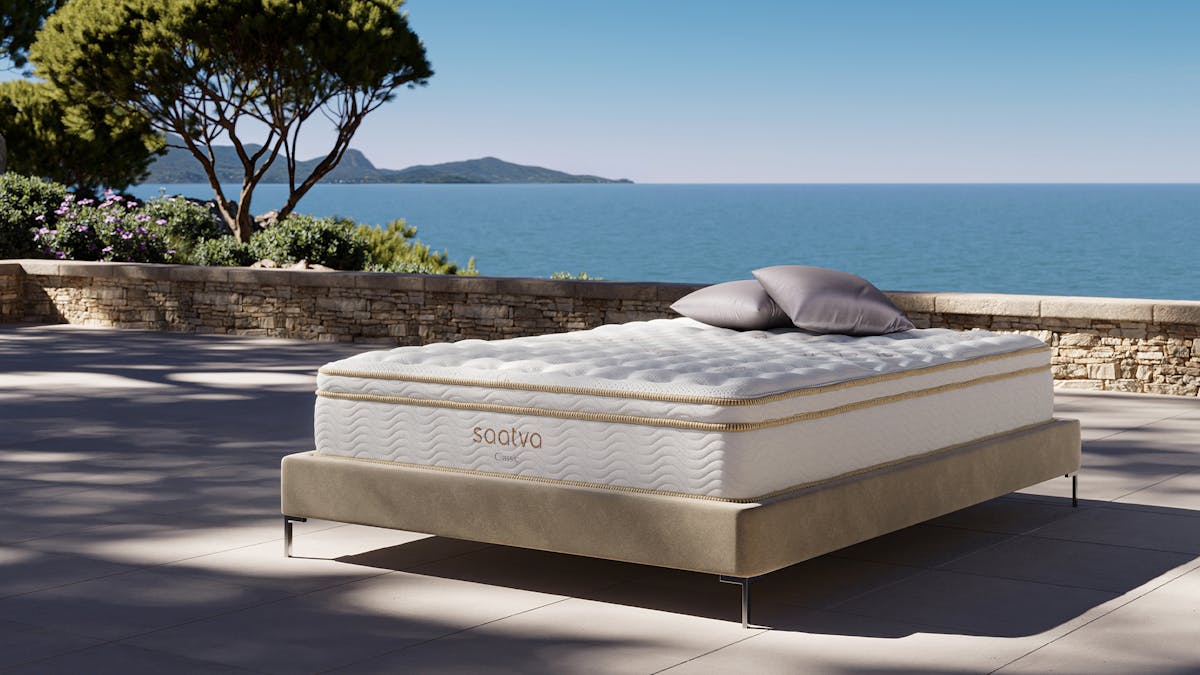
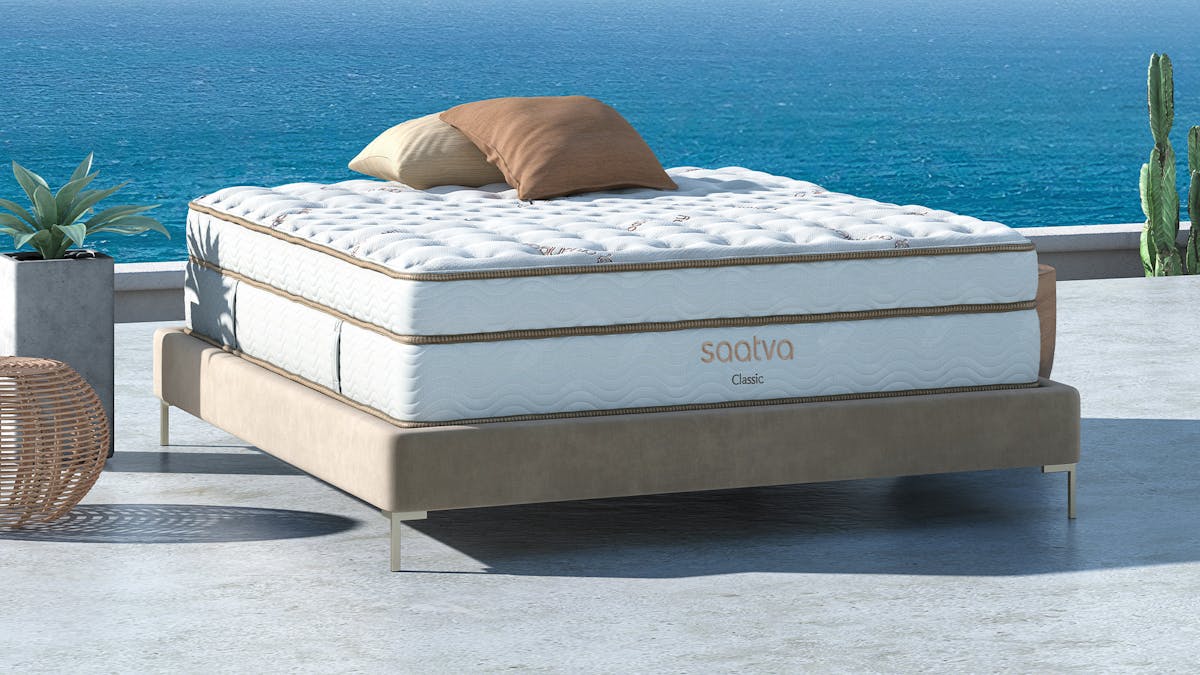
This is Saatva flagship and the mattress most people mean when they say "a Saatva ." It's a coil-on-coil innerspring design with a Euro pillow-top, built to feel like a traditional hotel luxury mattress rather than a foam bed. With over 5,600 reviews, it has by far the largest track record of any model in the lineup.
Contour5 — Cooling Ultra-Premium Memory Foam
- Rating: 4.7 stars (74 reviews)
- Sale price: $1,657–$3,441
- Original price: $1,949–$4,048
- Savings: Up to $607
- Financing: 0% APR or from $93/month with Affirm
Saatva premium all-foam option, aimed at people who want the classic memory-foam contour and motion isolation but with cooling technology layered in to counteract the heat retention foam is known for.
Saatva Latex Hybrid — Organic Natural Latex Hybrid
- Rating: 4.8 stars (367 reviews)
- Sale price: $1,487–$3,144
- Original price: $1,749–$3,698
- Savings: Up to $554
- Financing: 0% APR or from $83/month with Affirm
Combines a coil support core with organic natural latex comfort layers — a middle-ground pick for shoppers who want the eco-friendly, responsive feel of latex without going fully into Zenhaven territory (see below).
Solaire — Adjustable Firmness
- Rating: 4.7 stars (149 reviews)
- Sale price: $2,975–$5,949
- Original price: $3,499–$6,998
- Savings: Up to $1,049 (the largest dollar discount in the entire lineup)
- Financing: 0% APR or from $124/month with Affirm
Saatva air-adjustable mattress, letting each side of the bed be tuned to a different firmness level digitally. It's the most expensive mattress Saatva sells, and correspondingly carries the single biggest sale discount.
Memory Foam Hybrid — Cooling Premium Memory Foam Hybrid
- Rating: 4.8 stars (304 reviews)
- Sale price: $1,190–$2,591
- Original price: $1,399–$3,048
- Savings: Up to $457
- Financing: 0% APR or from $67/month with Affirm
The most affordable hybrid in the current sale, pairing a coil base with cooling memory foam comfort layers. This is the value pick if you want hybrid support without paying Classic or Contour5 prices.
Zenhaven — Dual-Sided Organic Natural Latex
- Rating: 4.9 stars (346 reviews — the highest rating of any model on the page)
- Sale price: $1,785–$4,207
- Original price: $2,099–$4,949
- Savings: Up to $742
- Financing: 0% APR or from $100/month with Affirm
A flippable, dual-sided all-latex mattress offering two firmness levels in one bed (flip it over for a different feel). It holds the highest star rating on Saatva entire sale page.
Saatva HD — Hybrid Mattress for Bigger Bodies
- Rating: 4.9 stars (254 reviews)
- Sale price: $1,742–$3,951
- Original price: $2,049–$4,648
- Savings: Up to $697
- Financing: 0% APR or from $97/month with Affirm
Reinforced coils and denser foam specifically engineered for plus-size sleepers and couples over roughly 300 lbs combined, where standard mattresses tend to sag prematurely.
Saatva Rx — Memory Foam Hybrid for Chronic Back Pain
- Rating: 4.8 stars (450 reviews)
- Sale price: $1,742–$3,951
- Original price: $2,049–$4,648
- Savings: Up to $697
- Financing: 0% APR or from $97/month with Affirm
Identical pricing structure to the Saatva HD, but engineered with targeted lumbar support and a firmer perimeter, marketed specifically toward people managing chronic back pain.
Saatva Youth — Dual-Sided Hybrid
- Rating: 4.8 stars (38 reviews)
- Sale price: $680–$926
- Original price: $799–$1,089
- Savings: Up to $163
- Financing: 0% APR or from $38/month with Affirm
A kids' mattress designed to grow with a child — one firmer side for younger kids, one softer side to flip to as they get older. It's the only model on the page without a compare/save-later option, since it's typically shopped in a single fixed configuration rather than compared across sizes and firmnesses the way adult mattresses are.
Quick Comparison Table
| Mattress | Type | Rating | Reviews | Sale Price | Savings |
|---|---|---|---|---|---|
| Saatva Classic | Luxury Innerspring | 4.8 | 5,647 | $1,232–$2,727 | Up to $481 |
| Contour5 | Cooling Memory Foam | 4.7 | 74 | $1,657–$3,441 | Up to $607 |
| Saatva Latex Hybrid | Organic Latex Hybrid | 4.8 | 367 | $1,487–$3,144 | Up to $554 |
| Solaire | Adjustable Firmness | 4.7 | 149 | $2,975–$5,949 | Up to $1,049 |
| Memory Foam Hybrid | Cooling Memory Foam Hybrid | 4.8 | 304 | $1,190–$2,591 | Up to $457 |
| Zenhaven | Dual-Sided Latex | 4.9 | 346 | $1,785–$4,207 | Up to $742 |
| Saatva HD | Hybrid for Bigger Bodies | 4.9 | 254 | $1,742–$3,951 | Up to $697 |
| Saatva Rx | Hybrid for Back Pain | 4.8 | 450 | $1,742–$3,951 | Up to $697 |
| Saatva Youth | Dual-Sided Hybrid (Kids) | 4.8 | 38 | $680–$926 | Up to $163 |
A few things jump out from this table. First, the Memory Foam Hybrid is the cheapest full-size adult mattress in the lineup, making it the entry point for shoppers on a budget. Second, Zenhaven and Saatva HD share the highest star rating on the page at 4.9, despite serving very different sleeper needs. Third, percentage-wise, the discounts land in a fairly consistent 15–17% range across almost every model, which tells you this is a structured seasonal sale rather than random clearance pricing on a few unpopular SKUs.
3. Pros and Cons of Buying a Saatva Mattress
No mattress brand is right for everyone, and it's worth weighing the tradeoffs before you commit — especially at these price points.
Pros
Genuine variety across sleep needs. Few direct-to-consumer brands offer nine distinct models spanning innerspring, memory foam, latex, hybrid, adjustable, plus-size, back-pain-specific, and kids' mattresses under one roof. Most competitors sell two or three foam variants and call it a day.
Strong review volume and ratings. The Saatva Classic alone has 5,647 reviews at a 4.8 average, and the lineup's lowest rating on the entire page is still 4.7. That's a meaningfully large, consistent body of customer feedback to lean on.
In-person "Viewing Rooms." Unlike many bed-in-a-box brands, Saatva operates physical viewing rooms where you can test the exact mattress before your 365-night trial even starts — a real advantage if you're skeptical of buying a mattress sight-unseen.
Long trial and warranty terms. A 365-night home trial, free delivery and setup, free mattress removal (of your old mattress), and a lifetime warranty are all standard, not upsells.
Flexible financing. Every mattress on the page qualifies for 0% APR financing through Affirm, with monthly payments starting as low as $38/month for the Saatva Youth.
Specialized models solve specific problems. The Saatva HD and Saatva Rx exist precisely because generic mattresses fail specific groups — heavier sleepers and chronic back pain sufferers, respectively. That level of targeting is uncommon.
Cons
Premium pricing, even on sale. Even with hundreds of dollars knocked off, Saatva mattresses start around $1,200–$1,700 for a full-size adult bed and climb past $5,900 for a top-of-the-line Solaire. Budget shoppers comparing against $500–$800 bed-in-a-box competitors will find Saatva considerably more expensive.
White-glove delivery cuts both ways. Saatva doesn't ship in a compressed box — it delivers and sets up the mattress in your room, which is convenient, but it also means delivery windows are less flexible than a box left on your porch, and it's not something you can pick up same-day from a local store.
Overlap between similarly priced models can be confusing. The Saatva HD and Saatva Rx are priced identically ($1,742–$3,951) despite targeting different sleeper problems, and the Memory Foam Hybrid, Saatva Latex Hybrid, and Saatva Classic all occupy a similar price band with different materials. Shoppers who don't already know what firmness or material they want may need to lean on the mattress quiz or a phone consultation to avoid decision fatigue.
Review counts vary wildly by model. The Classic has thousands of reviews; the Saatva Youth has 38 and the Contour5 has 74. That's not necessarily a red flag — newer or more niche products naturally have fewer reviews — but it does mean the newer models carry more uncertainty than the flagship line.
Sale savings scale with price, not need. The biggest dollar-value discount ($1,049) is on the most expensive mattress (Solaire), which is standard retail practice but worth noting: shoppers buying the cheaper models save a smaller amount even though the percentage discount is similar across the board.
4. Saatva Bundles: Are They Worth It?
Saatva's bundle strategy is built around a simple pitch printed right on the page: "These savings stack, so the more you buy with your mattress, the more you save." Here's what's currently bundled and discounted.
Classic Bundle — Mattress with Mattress Pad, Foundation & Universal Frame
- Sale price: $1,614–$3,351
- Original price: $1,918–$3,982
- Savings: Up to $631
This pairs the Saatva Classic with everything you'd need to actually set the mattress up from scratch — a foundation, universal bed frame, and protective mattress pad — for a total savings of $631, noticeably more than the $481 you'd save buying the Classic mattress alone.
Saatva Latex Hybrid Bundle — Mattress with Mattress Pad, Foundation & Universal Frame
- Sale price: $1,869–$3,768
- Original price: $2,218–$4,472
- Savings: Up to $704
Same accessory package as the Classic Bundle, applied to the Saatva Latex Hybrid mattress instead, with a slightly larger total discount.
Back Pain Bundle — Mattress with Adjustable Base
- Sale price: $2,209–$4,817
- Original price: $2,698–$5,766
- Savings: Up to $949
This is the priciest bundle on the page, pairing (presumably the Saatva Rx) with an adjustable base — the single biggest savings figure among the bundles, just short of the $1,049 saved on a standalone Solaire.
Bestsellers Bedding Bundle
- Sale price: $379–$672
- Original price: $445–$850
- Savings: Up to $178
A non-mattress bundle, likely combining sheets, a comforter, and pillows based on the surrounding bedding imagery on the page.
Luxury Comfort Bedding Bundle
- Sale price: $281–$498
- Original price: $330–$645
- Savings: Up to $147
Cooling Comfort Bedding Bundle
- Sale price: $281–$498
- Original price: $330–$645
- Savings: Up to $147
These two bedding bundles are priced identically, with the difference presumably coming down to fabric/fill temperature properties (luxury vs. cooling) rather than price.
Bottom line on bundles: if you're setting up a bedroom from zero — no frame, no foundation, no pad — the Classic and Saatva Latex Hybrid bundles are worth serious consideration, since the bundled discount outpaces buying the mattress alone and then separately purchasing a frame and foundation at full price. The Back Pain Bundle is the highest-value stack on the page in absolute dollar terms, but only makes sense if you were already planning to buy an adjustable base.
5. Extra Savings on Bedding, Frames, and Furniture
Beyond mattresses and bundles, Saatva's sale page includes several standalone promotions worth knowing about if you're outfitting an entire bedroom:
- Adjustable bases: Save $100 on every Saatva Adjustable Base
- Bed frames: Save $100 on every bed frame
- Mattress foundations: Save up to $40 on every mattress foundation
- Pillows: Buy a pillow pair and save up to $60
- Nightstands: Get two nightstands and save $200, plus an extra 30% off specifically on the Leo 30" and Hyde nightstand styles
- Bedroom rugs: An extra 40% off select styles, including:
- Cirrus Rug — $508–$814 (was $995–$1,595), saving up to $781
- Navi Rug — $406–$712 (was $795–$1,395), saving up to $683
- Adamas Rug — $457–$763 (was $895–$1,495), saving up to $732
The rug discounts stand out as the steepest percentage markdowns anywhere on the page — roughly 49% off across all three styles — even though rugs aren't the headline product most people come to Saatva for. If you're already buying a mattress and need to refresh the room around it, this is where the sale quietly offers its best percentage value.
6. Frequently Asked Questions
Saatva's own FAQ section on the sale page flags three questions shoppers consistently ask. Here's how to think through each one:
Does Saatva have coupons, discounts, or promo codes?
Saatva's savings are generally built directly into the listed sale price rather than requiring you to hunt down and apply a separate promo code at checkout. The discounts shown throughout this page — the per-model dollar savings, the bundle pricing, and the Fourth of July Sale markdowns — are already reflected in the prices displayed. If you're specifically looking for a personal code (student, teacher, military, medical, first responder), it's worth checking Saatva's discount program page directly, since eligibility-based codes are typically handled separately from the site-wide seasonal sale.
Does Saatva offer any discounts to first responders, veterans, active military & more?
The site does maintain a dedicated discount program for groups like these, referenced in the footer under "Saatva discount program." The 15% Patient Discount banner running across the top of the sales page is one visible example of this type of targeted discount. Because eligibility verification and exact terms can change, the most reliable way to confirm your specific discount is to check the discount program page or speak with a Saatva representative directly (Saatva's phone line is 1-860-453-5276).
What's the best way to find out about current sales?
Based on how the page itself is structured, there are three consistent channels: the sales page you're currently reading (updated to reflect live seasonal pricing like the Fourth of July Sale), the email signup at the bottom of the site ("Get access to our latest sales, product news & sleep tips"), and direct contact through chat, phone, or the mattress quiz if you want a sale explained to you in the context of your specific sleep needs.
7. Final Verdict: Who Should Buy From Saatva Right Now
If you're currently comparing mattresses and trying to decide whether now is the time to buy, here's the honest breakdown:
Buy now if: You've already narrowed down which Saatva model fits your sleep style, and you're setting up a full bedroom (mattress plus frame, foundation, and bedding), since that's where the bundle math clearly beats buying piece by piece. The Fourth of July Sale discounts are applied consistently across nearly every model and category, so there's no obvious "wait for a better deal" model sitting untouched — the savings are already live.
Take the quiz first if: You're not sure whether you want an innerspring (Classic), latex (Latex Hybrid or Zenhaven), memory foam (Contour5 or Memory Foam Hybrid), or a specialized option (HD, Rx, or Solaire). With nine models at overlapping price points, matching your body type, sleep position, and any pain points to the right mattress matters more than chasing the single biggest discount number.
Consider the 365-night trial as your real safety net. Because Saatva's return policy is this generous, the financial risk of picking the "wrong" model from the lineup is lower than it looks on paper — which makes this a reasonable time to buy even if you're not 100% certain between two similar options.
Whichever model you land on, cross-reference the numbers in the comparison table above against your budget and needs before checking out, and don't skip the bundle options if you need a frame or foundation — that's where this particular sale delivers its strongest math.